1. Introduction: A Tale of Two Payment Revolutions
The global payments landscape, long defined by the multi-day settlement cycles of correspondent banking and the fee-laden infrastructure of card networks, is being fundamentally reshaped. The inherent inefficiencies of these legacy systems such as high costs, slow speeds, and limited operating hours have created fertile ground for disruption. From this environment, two powerful challengers have emerged, approaching the problem from fundamentally different philosophical and architectural standpoints.
- Instant Payment Systems (IPS): These are government-operated, real-time domestic payment systems. India’s Unified Payments Interface (UPI) and Brazil’s Pix are digital public infrastructures built to facilitate instant, low-cost, 24/7 payments directly between bank accounts within their respective countries. Backed by their central banks, they function as public utilities designed to enhance financial inclusion, reduce reliance on cash, and create a competitive alternative to private card networks.
- Stablecoins: These are blockchain-based digital tokens, privately issued and pegged to a stable asset like the U.S. dollar. Operating on global, 24/7, and largely permissionless blockchain networks, stablecoins like USDC (USD Coin issued by Circle, USDT (USD Tether issued by Tether Limited), and PYUSD (PayPal USD issued by Paxos Trust Company) enable near-instant, low-cost value transfer directly between users, anywhere in the world, often outside the direct purview of the traditional banking system.
These new rails are actively rerouting billions of dollars in transaction flows, creating new categories of risk, and fundamentally challenging the business models of established financial institutions. For audit and risk teams, understanding the distinct risk-opportunity profiles of both private, blockchain-based systems and government-run payment utilities is now essential for effective and forward-looking risk management.
2. Adoption & Operating Models: Global vs. Domestic Disruption
The distinct value propositions of these two models are clearly illustrated by their real-world adoption patterns: Stablecoins are solving for global friction, while UPI and Pix are solving for domestic efficiency.
UPI & Pix: A Domestic Utility
UPI and Pix are centralized systems built on top of existing banking infrastructure, managed or overseen by a national entity (the National Payments Corporation of India and the Central Bank of Brazil). They allow users to make instant payments using a unique virtual ID (like a phone number or email) or by scanning a QR code, which triggers a real-time transfer of funds between the payer’s and payee’s bank accounts.
Adoption Examples:
- UPI (India): Since its 2016 launch, UPI has become the backbone of India’s retail economy. It processes over 18 billion transactions per month and recently (June 2025) surpassed Visa’s global network in daily transaction volume. Driven by a zero-fee policy for users and a simple, interoperable QR code system, UPI accounts for over 85% of all digital payment transaction volume in India across 450 million users. (Source: International Monetary Fund, 2025; NPCI)
- Pix (Brazil): Launched in late 2020, Pix is now used by 76% of the Brazilian adult population (approx. 150 million users). In 2024, Pix processed nearly 60 billion transactions, a massive increase from the 42 billion payments in 2023. This continued explosive growth further cements Pix’s position as the dominant payment method in Brazil, far surpassing the combined use of credit and debit cards for transaction volume
- One of every ten adults in the world uses either Pix or UPI to send or receive immediate payments.
Stablecoins: A Global Solution for Cross-Border Inefficiency
Stablecoin adoption is concentrated in use cases that exploit the weaknesses of the traditional financial system. An issuer accepts fiat currency (e.g., U.S. dollars) and in return mints an equivalent number of tokens on a public blockchain. These tokens can then be transferred globally, peer-to-peer, with the blockchain acting as the settlement ledger. The promise of 1:1 redeemability with the underlying reserve asset is what maintains the peg.
Adoption Examples:
- Institutional: Major financial institutions are leveraging the technology for wholesale payments. For example, J.P. Morgan’s JPM Coin and JPMD (a tokenized deposit on a public blockchain) allow institutional clients to conduct 24/7 cross-border settlements.
- Business: The primary business use case is bypassing the slow and costly correspondent banking system for B2B payments. Companies like Shopify have integrated USDC payments to reduce merchant fees compared to credit cards.
- Consumer: Stablecoins are used extensively for cross-border remittances, offering a cheaper and faster alternative to traditional money transfer operators. They have also become a vital tool for preserving savings in countries with high inflation, such as Argentina and Turkey.
The two models present fundamentally different profiles across key operational and regulatory attributes.

3. Disruptive Impact on Incumbents
Both payment rails pose an existential threat to the business models of traditional financial intermediaries, particularly commercial banks and card networks.
- Banks: IPS weaken banks’ role in payments by making transfers instantaneous and nearly free, eroding fee income, float revenue, and customer stickiness. Stablecoins raise the stakes further by creating non-bank money alternatives that could drain deposits and bypass correspondent banking entirely. If adoption scales, banks face disintermediation in both domestic and international transaction flows.
- Credit and Debit Card Networks: IPS directly undercut card networks by enabling low-cost account-to-account transfers, reducing debit card usage and pressuring interchange fees. Stablecoins extend this disruption globally by enabling direct merchant settlement outside of card rails. This threatens to displace card networks’ central role as intermediaries, forcing them to pivot toward blockchain-based services.
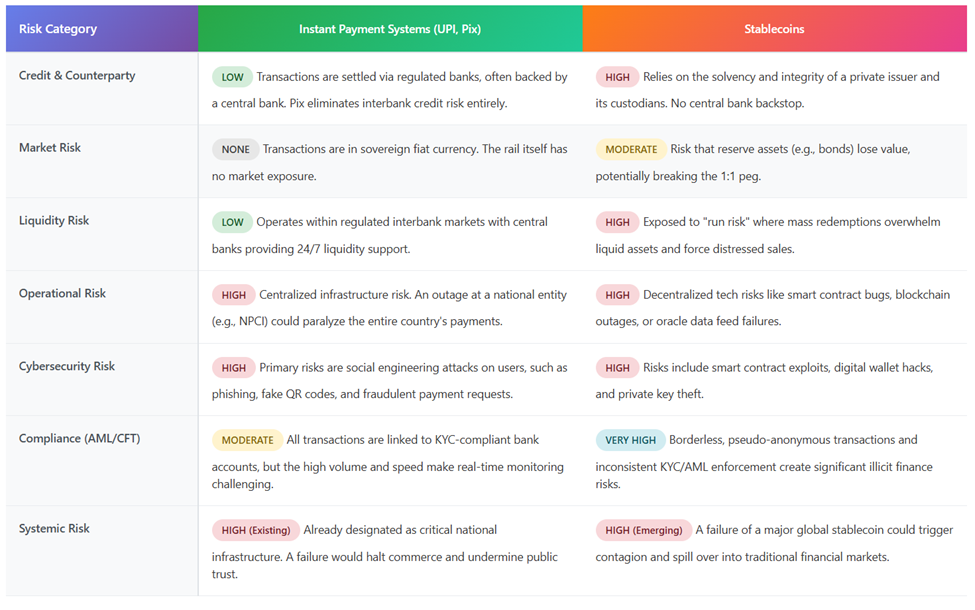
4. Key Risk Considerations
To effectively manage this new landscape, professionals must understand the unique risk profiles of IPS and Stablecoin ecosystems.
5. Key Audit and Risk Management Focus Areas
Building on the risk assessment, audit and risk management plans must incorporate specific procedures to validate the controls and integrity of each payment rail.
Focus Areas for Stablecoin Evaluation
- Reserve Integrity and Transparency: Verify that the issuer’s reserve attestations are frequent, transparent, and conducted by a reputable firm. Scrutinize the composition and credit quality of reserve assets.
- Redemption Rights and Processes: Test the legal and practical terms for redeeming tokens into fiat. Identify barriers (e.g., high minimums, fees) that could impede redemptions during market stress.
- AML/CFT Compliance: Ensure compliance with regulations like the FATF Travel Rule. Verify that blockchain analytics tools are used effectively to detect and prevent illicit activity.
- Tax and Accounting Treatment: Confirm the proper balance sheet classification of stablecoin holdings and verify that a clear process exists to determine fair market value for tax purposes.
Focus Areas for UPI/Pix Integration
- Disaster Recovery and Business Continuity: Verify that documented BCPs exist for central infrastructure outages (NPCI/BCB) and, crucially, that these plans are regularly tested.
- Data Governance and Privacy: Audit controls to ensure customer data is protected in compliance with local privacy laws.
- Third-Party Risk Management (UPI-specific): Assess the due diligence and ongoing monitoring performed on critical Third-Party Application Providers (TPAPs). Review contracts for clear liability assignments.
- Cross-Border Expansion Contingencies: As these systems expand internationally, check that plans effectively address the varying regulatory and AML/CFT standards of partner countries.
6. Looking Ahead: The CBDC Factor
The evolution of digital payments continues with the potential emergence of a third rail that could merge the characteristics of the first two: Central Bank Digital Currencies (CBDCs). A CBDC is a digital form of a country’s fiat currency that is a direct liability of the central bank, making it the safest form of digital money.
CBDCs could blur the line between private stablecoins and state-owned payment rails. They combine government issuance with digital settlement and could integrate directly into systems like UPI or Pix as a new, risk-free settlement asset. For risk and audit teams, this raises new questions around interoperability and control testing, while also presenting challenges due to the current absence of specific accounting and auditing standards for this new asset class.
Conclusion
The global payments system is at a historic inflection point. Private, decentralized stablecoins offer a vision of a global, borderless financial future. Public, centralized instant payment systems like UPI and Pix demonstrate the power of digital public infrastructure to deliver efficiency and inclusion at a national scale.
For audit and risk professionals, the key is to move beyond a monolithic view of “digital payments” and develop the specialized expertise to assess each system on its own terms. This requires a deep understanding of everything from blockchain security and reserve asset quality to third-party application risk and the operational resilience of national infrastructure. The question for every organization is no longer if they will engage with these new payment rails, but how.
 Risk Ascent | Exploring the Edges of Risk
Leave a comment